OTA 1997 Posters - Pelvic & Acetabular Fractures
The Operative Treatment of Acetabular Fractures through the Extensile Henry Approach
John T. Wey, MD, Doreen DiPasquale, MD, Louis E. Levitt, MD, Hiram M. Quitkin, MD
Washington, District of Columbia, USA
The purpose of this study was to evaluate the previously unreported application of the extensile Henry approach to the operative treatment of acetabular fractures.
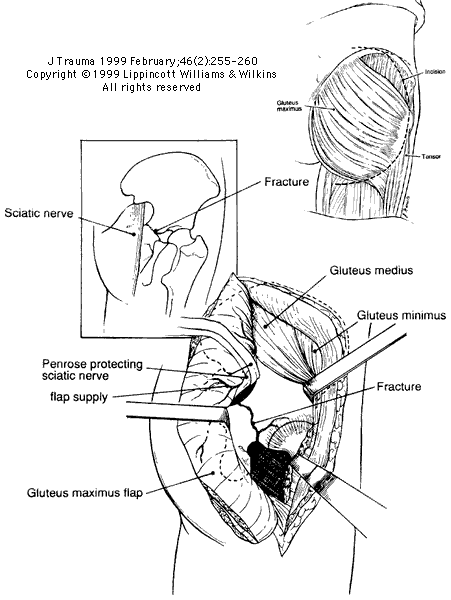
From 1990 to 1996, all surgically treated acetabular fractures were managed by the senior two authors using the extensile Henry approach. With the patient in the lateral decubitus position, a curvilinear incision was made along the posterior iliac crest advancing anteriorly over the greater trochanter and then curving posteriorly towards the gluteal folds. After splitting the interval between the gluteus maximus muscle and the iliotibial tract, the gluteus maximus was released from its tendinous insertion. It was then reflected posteriorly to provide exposure of the entire posterior pelvis and direct visualization of the sciatic nerve. The short external rotators were then detached and the joint capsule incised to expose the fracture site. A subperiosteal exposure was carried out along the ischium and ilium to expose the posterior column and wall. Through the extensile exposure, fractures of the anterior column could be indirectly reduced using manual manipulation through the sciatic notch. The reduction was evaluated by C-arm, palpation of the quadrilateral plate, and direct visualization of the joint. Post-operatively, either low dose radiation or Indocin was used for heterotopic ossification prophylaxis.
Thirty-one cases were retrospectively reviewed at an average followup of 18.5 months. There were 6 posterior wall, 1 T-type, 13 associated transverse and posterior wall, 2 transverse, 6 both column, and 3 posterior column and posterior wall fracture patterns. The average time from injury to surgery was 9 days thus allowing for hematoma stabilization. The average operative time was 4.5 hours (range 2.5 hours to 8 hours) with an average blood loss of 1160 ml (range 350 ml to 2500 ml). Reduction was anatomic in 26 cases (84%), satisfactory in 4 cases (13%), and unsatisfactory in 1 case (3%). Radiographic results at followup were 25 excellent results (81%), 4 good results (13%), and 2 poor results (6%). No heterotopic ossification occurred in 24 cases (77%). There were 4 cases of low grade (Brooker Class I, II) and 3 cases of high grade heterotopic ossification (Class III, IV). The low grade cases occurred in 2 patients who received low dose radiation treatment, 1 patient treated with Indocin, and 1 patient who received no prophylaxis.
The 3 cases of high grade heterotopic ossification all occurred in patients who underwent prophylaxis with Indocin. An additional complication was 2 cases of superficial wound infection. There were no iatrogenic injuries to the sciatic nerve or development of flap necrosis.
The extensile Henry approach is a versatile approach offering an excellent exposure for the surgical treatment of acetabular fractures. The direct exposure of the posterior pelvis significantly minimizes the risk of iatrogenic injury to the sciatic nerve. In addition, the incidence of clinically significant heterotopic ossification may be reduced through the use of low dose radiation prophylaxis.